
A night guard and a sleep appliance may both be worn while you sleep, but they are not designed to do the same job.
If you grind or clench your teeth, a custom night guard may be discussed to help protect the teeth and address some of the dental strain associated with those habits. A sleep appliance, such as a mandibular advancement device, is designed for a different purpose and may be considered for appropriately evaluated patients with certain sleep-related breathing concerns.
Understanding night guard vs sleep appliance differences starts with one question: What problem is the appliance supposed to address?
The answer affects the design of the device, the evaluation needed beforehand, and the type of follow-up that may be appropriate.
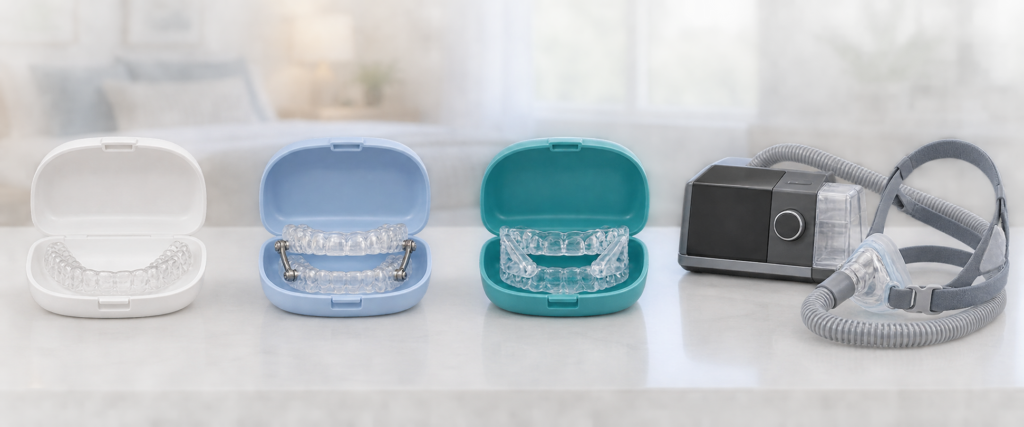
What Is a Night Guard and When Might You Need One?
A night guard is a dental appliance that fits over the teeth and is commonly worn during sleep.
One of its most common uses is helping protect teeth from the repeated forces associated with clenching or grinding. These habits can place stress on the teeth, existing dental restorations, and the jaw.
Custom night guards may be considered when a patient has concerns related to:
- nighttime clenching
- teeth grinding
- visible tooth wear
- stress on existing restorations
- certain bite-related concerns
- some TMJ or TMD issues associated with clenching or strain
A night guard is not automatically the correct appliance for every patient with jaw discomfort or tooth wear.
The dentist still needs to evaluate what is contributing to the concern and whether an appliance makes sense for that individual situation.
Pacific Dental Center also provides conservative TMJ treatment that may include bite evaluation, custom nightguards, clenching and strain reduction, jaw-relaxation guidance, home-care recommendations, and restorative treatment when relevant.
What Is a Sleep Appliance and When Is It Used?
A sleep appliance serves a different clinical purpose.
One example is a mandibular advancement device. Rather than simply protecting the teeth, this type of appliance is designed to position the lower jaw forward during sleep.
Mandibular advancement devices may be considered for appropriately evaluated patients with certain sleep-related breathing concerns.
When obstructive sleep apnea is involved, the medical and dental roles are different.
A physician or sleep provider is responsible for diagnosing and medically monitoring OSA. The dentist evaluates whether the patient’s teeth, gums, bite, jaw movement, TMJ comfort, and existing dental work can appropriately support oral appliance therapy.
That distinction matters because a sleep appliance is not simply another style of night guard.
Night Guard vs. Sleep Appliance: What’s the Main Difference?
The biggest difference is the purpose of the appliance.
| Night Guard | Sleep Appliance | |
| Primary purpose | Addresses dental concerns such as clenching, grinding, and tooth protection | May help manage certain sleep-related breathing concerns |
| Common design goal | Protect the teeth and account for bite and jaw factors | Influence jaw position during sleep |
| Sleep apnea treatment? | A standard night guard is not OSA treatment | May be considered for appropriately evaluated patients |
| Evaluation needed | Dental evaluation | Medical or sleep evaluation plus dental assessment |
The fact that both appliances may be worn overnight does not make them interchangeable.
Choosing an appliance should begin with identifying the actual concern rather than choosing based on appearance or convenience.
Can a Night Guard Help With Sleep Apnea?
A standard night guard should not be considered a substitute for a sleep appliance used as part of appropriate OSA care.
Night guards and mandibular advancement devices may both fit inside the mouth, but they are designed differently and have different treatment goals.
If you have concerns about obstructive sleep apnea, diagnosis and medical monitoring belong with the appropriate physician or sleep provider.
The dentist’s role is different.
Pacific Dental Center evaluates dental factors that may affect whether an oral appliance is appropriate, including the teeth and gums, bite, jaw movement, TMJ comfort, existing restorations, grinding or clenching, and the ability to support the appliance.
A dentist does not replace a physician or sleep specialist in diagnosing or medically monitoring OSA.
How Does a Dentist Decide Which Appliance May Be Appropriate?
Choosing an appliance involves more than deciding which one looks comfortable.
We may evaluate factors such as:
- the condition of your teeth and gums
- your bite
- jaw movement
- TMJ comfort
- existing crowns, bridges, fillings, or other restorations
- evidence of grinding or clenching
- tooth wear
- the concern you are trying to address
- whether your mouth can appropriately support a particular oral appliance
The purpose of the evaluation is to connect the appliance to the problem.
Someone whose main concern is nighttime grinding may have a very different treatment discussion from a patient who has already been evaluated for a sleep-related breathing disorder and is exploring oral appliance therapy.
A custom appliance also allows the dentist to consider the individual mouth rather than treating the device as one-size-fits-all.
Your bite, jaw movement, existing dental work, and overall oral health can all affect appliance design and monitoring.
Can a Sleep Appliance Be Considered If You Cannot Tolerate CPAP?
Some patients explore oral appliance therapy because they have difficulty tolerating CPAP.
That does not mean they should stop CPAP or change physician-directed treatment on their own.
Pacific Dental Center provides CPAP intolerance consultations for patients who want to discuss whether an oral appliance may be appropriate from a dental perspective.
For a patient with diagnosed OSA, the process may involve coordination between the dental team and the physician or sleep provider.
The physician or sleep provider remains responsible for medical diagnosis and monitoring. The dentist evaluates the dental and jaw factors involved in oral appliance therapy.
An oral appliance may be an option for some patients, but it does not universally replace CPAP.
What If You Grind Your Teeth and Also Have Sleep-Related Breathing Concerns?
Some patients have more than one concern.
For example, a person may grind or clench their teeth while also having a diagnosed or suspected sleep-related breathing issue.
That does not mean one appliance can automatically address everything.
A conventional night guard may be appropriate for certain grinding-related concerns but is not automatically an OSA treatment. A sleep appliance has a different goal and requires a different type of evaluation.
The dentist may need to consider:
- tooth wear
- existing restorations
- bite
- jaw movement
- TMJ comfort
- clenching or grinding patterns
- information from the physician or sleep provider
- whether a particular appliance can be safely supported
The goal is to separate the different concerns and determine what each one actually requires.
Which Appliance Should You Discuss With Your Dentist?
If you are deciding between a night guard and a sleep appliance, start with the reason you are considering an appliance in the first place.
If your primary concern is grinding, clenching, tooth wear, or certain jaw-related symptoms, the discussion may begin with a dental evaluation and night guard options.
If the concern involves sleep-related breathing or previously diagnosed obstructive sleep apnea, the conversation is different. Medical diagnosis and monitoring remain with the physician or sleep provider, while the dentist evaluates whether oral appliance therapy may be suitable from a dental perspective.
At Pacific Dental Center, we focus on understanding the concern before recommending an appliance. Our approach emphasizes listening, clear explanations, individualized treatment planning, and avoiding one-size-fits-all recommendations.
If you are unsure which type of appliance may fit your needs, contact us to schedule an evaluation and discuss your options.


